
No nursing license required
Remote care coordinator: the job and how to start
A care coordinator owns a referral from the moment the order is written until the visit actually happens: finding an in-network provider, confirming authorization and benefits, moving the records across, booking the appointment, and confirming the result came back. Closing the loop is the whole job.
This is one of the remote healthcare desks that medical virtual assistants (medical VAs) work.
Also advertised as: referral coordinator, patient care coordinator, care navigator, referral specialist.What does a remote care coordinator do?
Here is what the care coordinator does between clock-in and clock-out.
- Take the referral order and identify an in-network provider with availability
- Confirm coverage and any authorization the referral needs
- Send the clinical records the receiving provider requires
- Book the appointment and confirm the patient knows the details
- Chase the consult note back and close the referral in the record
How do you become a remote care coordinator?
Five steps take you from the license check to a first application.
- Check the license rule. This desk needs no nursing license. Read a posting to confirm any other requirement that employer sets.
- Take the free Care and Referral Coordination course. The course has 15 modules and 82 lessons, with 9 hours 50 minutes of lesson reading. It opens with the shared desk skills, then covers The Referral, Sent and Closed, Referral Coordination, and Payer Communication. Start the free course.
- Practice the work on scored cases. Work practice cases across 15 practice tracks. A fixed rulebook scores each attempt. Every case is fictional and holds no real patient data.
- Read real job postings. Search care coordinator openings on the job board to see what employers ask for, which license they name, and which hours they expect.
- Apply with proof of how you work. Put your practice work on a resume that shows how you handle the desk. Start with the medical VA resume guide. No course or app can promise a hire, and employers set pay.
Do you need a license or experience to work as a care coordinator?
No license required for coordination support, though clinical familiarity helps with specialty referrals. Employers screen for follow-through: the failure mode of this job is a referral nobody chased.
What does the free Care and Referral Coordination course cover?
The course has 15 modules and 82 lessons, with 9 hours 50 minutes of lesson reading. Every lesson is free. The first seven modules teach the shared desk skills. The rest are written for this desk.
- Phone Work: 4 lessons
- HIPAA by Rule: 4 lessons
- Queue Work: 4 lessons
- Work Trail: 6 lessons
- The Referral, Sent and Closed: 4 lessons
- Referral Coordination: 7 lessons
- Payer Communication: 4 lessons
- Desk Tools: 5 lessons
- Transitions of Care: 4 lessons
- The Discharge and the Contact Window: 4 lessons
- Home Health and Hospice: 4 lessons
- Case Management: 6 lessons
- Eligibility & Benefits: 15 lessons
- Terminology and Anatomy: 5 lessons
- Career Close: 6 lessons
You then work practice cases across 15 practice tracks. A fixed rulebook scores each attempt.
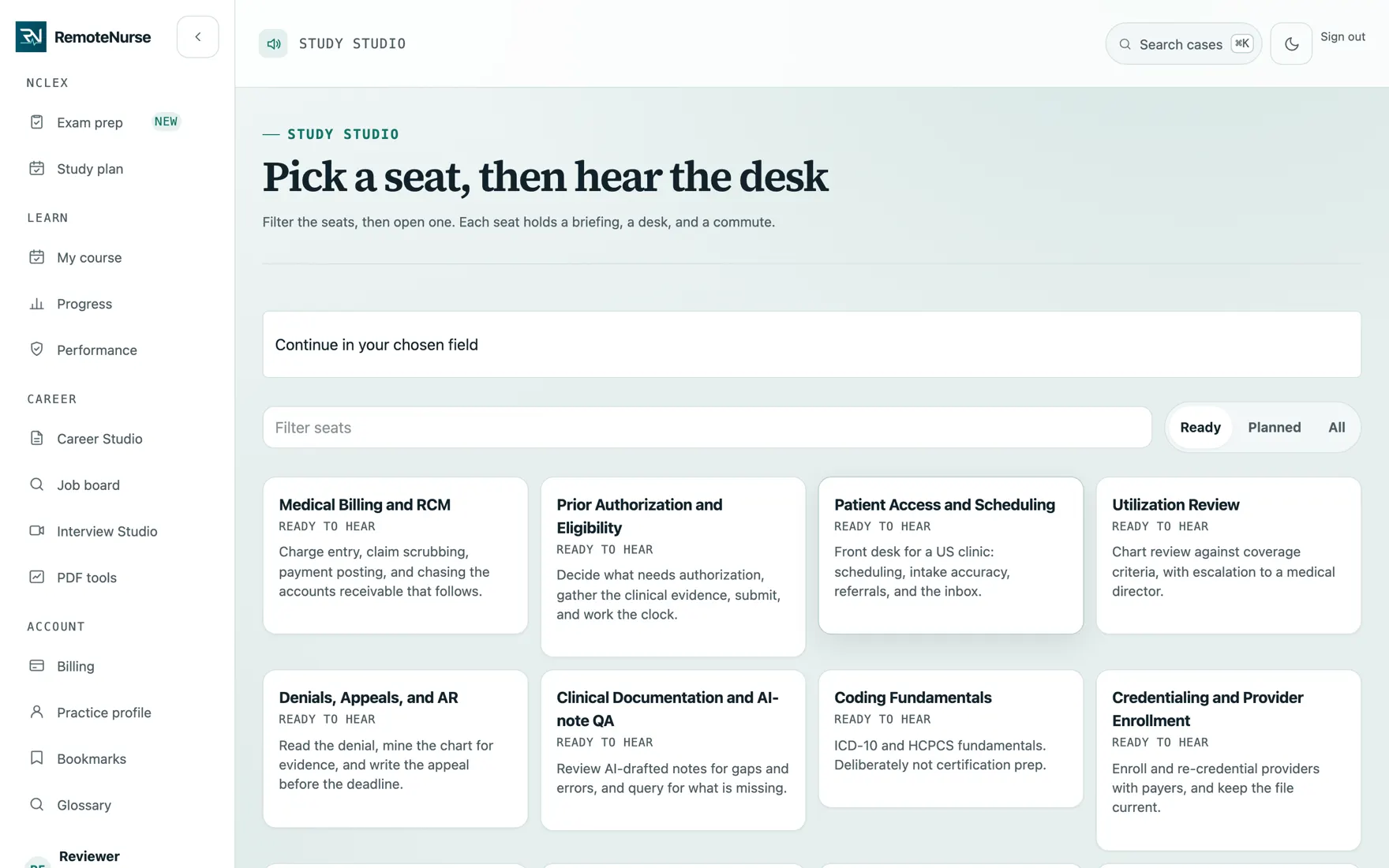
Related drills: HIPAA · study kit; CCM · study kit; ACM · study kit; Care and Referral Coordination desk · study kit.
You can also practice electronic health record chart audits on the free Simulated EHR Workspace.
All 16 courses are listed on the medical virtual assistant training page.
Who hires remote care coordinators?
Primary care and specialty practices, ACOs and value-based care organizations, care management companies, and medical VA agencies.
Search care coordinator openings for current employers. The agency directory shows who staffs these desks.
How much does a remote care coordinator earn?
RemoteNurse's researched pay band for this desk is $6-12/hr, PHP 30-50k/month.
- US RN license
- Not required
- Researched pay band
- $6-12/hr, PHP 30-50k/month
- Automation outlook
- Growing. Closed-loop work is what agencies hire as a patient care coordinator.
- Training maturity
- Practice: Deterministic workflow simulation with scored cases and safety paths.
Pay bands are ranges observed in public postings. Employers set pay.
What does a referral coordinator do?
A referral coordinator does the same desk under another title. They take the order, confirm the network and any authorization, send the records, book the visit, and chase the consult note until the referral is closed in the record.
How does a care coordinator compare with similar roles?
| Desk | US RN license | Researched pay band | What the desk does |
|---|---|---|---|
| Care and Referral Coordination (this page) | Not required | $6-12/hr, PHP 30-50k/month | Own a referral from the order to the completed visit, including the records it needs. |
| Utilization Review | Required | PHP 44-56k/month, the highest ceiling here | Chart review against coverage criteria, with escalation to a medical director. |
| RPM and Chronic Care Management | Not required | PHP 30-55k/month, RN preferred | Watch vitals dashboards, monitor transmission and route alerts under the approved protocol, and run the monthly care calls. |
Can you do this work from the Philippines?
The answer sits in each posting, which states the location, the hours, and the pay. Philippine-based candidates work these desks through medical VA agencies and healthcare outsourcing firms. For context, the Philippines healthcare BPO sector employs roughly 200,000 licensed clinical professionals and earns about $4.2B a year. (Outsource Accelerator, Philippines healthcare outsourcing). The Philippines starting guide covers routes and proof of skill.
Common questions
What is a closed-loop referral?
One where the receiving provider's note comes back and lands in the referring record, rather than a referral that was sent and never followed up. Closing the loop is the outcome coordination teams are measured on.
Where to go next
See live remote care coordinator openings to check what employers are asking for, browse the agency directory for who staffs this work, or compare all 16 roles if this one is not the right fit. Close siblings are Utilization Review and RPM and Chronic Care Management.