
No nursing license required
What does a prior authorization specialist do?
A prior authorization specialist decides whether a requested service needs an insurer's approval, gathers the clinical documentation that supports it, submits the request, and tracks it against the payer's decision deadline. The role is administrative: the specialist assembles and submits evidence, and a qualified clinical reviewer makes any decision to deny.
Also advertised as: prior auth specialist, authorization coordinator, pre-certification specialist, PA coordinator.What the job looks like day to day
- Check whether a scheduled service requires authorization under the member's plan
- Verify eligibility and benefits before the request goes out
- Pull the clinical notes, imaging, and history that support medical necessity
- Submit through the payer portal or by phone, and record the reference number
- Work the clock: follow up on pending requests before the decision deadline passes
Who hires for this
Clinics, hospital scheduling and access departments, specialty practices, billing companies, and the medical VA agencies that staff those teams.
What you need before you apply
No license is required. You need to understand plan types, what a benefit check tells you, and which clinical facts make a request complete. Accuracy under a deadline is the skill being screened for.
Pay and outlook, stated honestly
- US RN license
- Not required
- Researched pay band
- PHP 25-80k/month
- Automation outlook
- Transforming. Payers are dropping some gated services and CMS set timed decision clocks, so the skill is exception handling and clock management, not form-filling.
- Training maturity
- Practice: Deterministic workflow simulation with scored cases and safety paths.
Pay bands are researched ranges observed in public postings, not an offer and not a prediction of what you will earn. Employers set pay. RemoteNurse is training and practice, not a hiring guarantee.
How you practice this on RemoteNurse
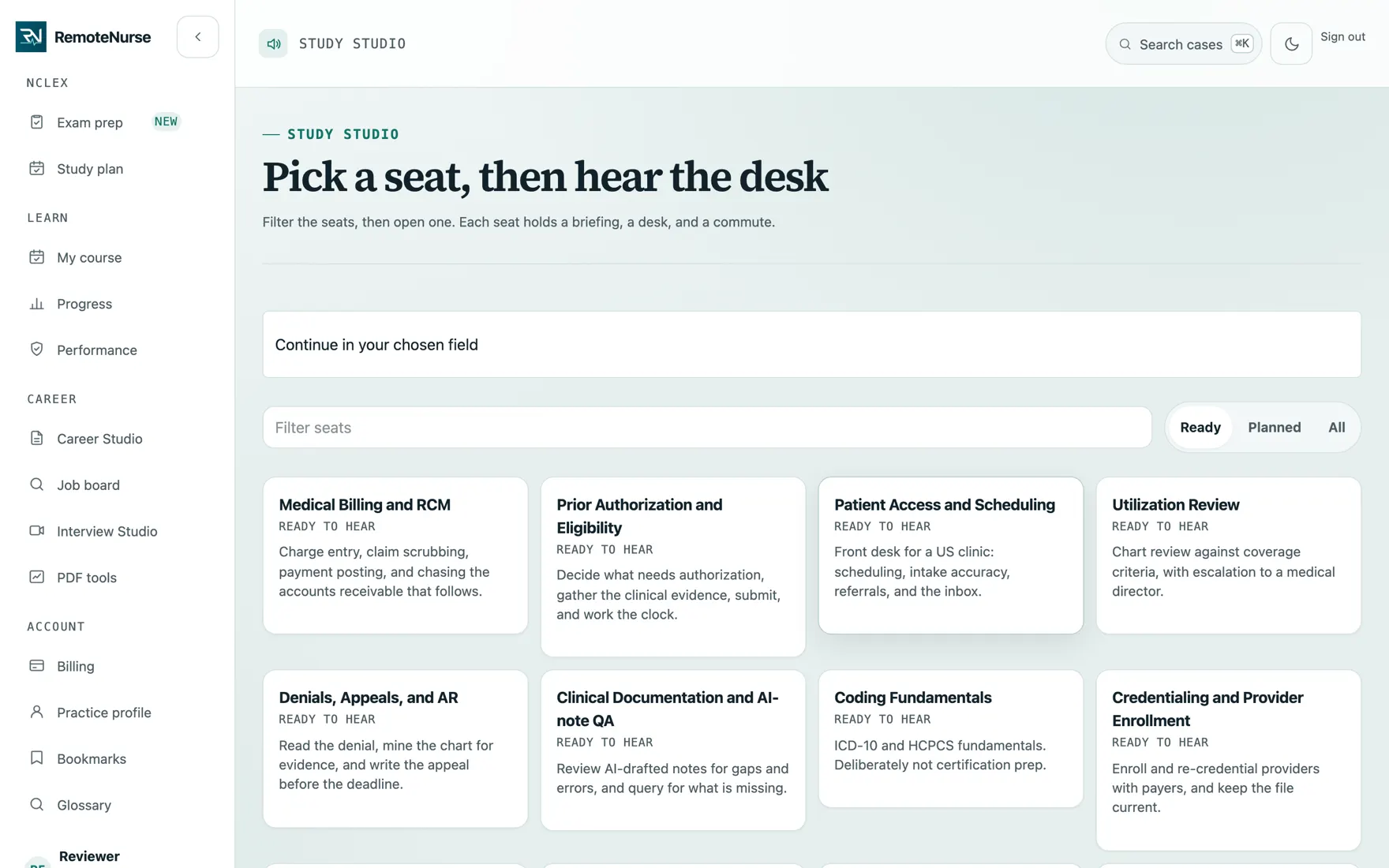
This desk draws on 15 practice tracks. You work synthetic cases in each, and a fixed rulebook scores the attempt.
Related drills: HIPAA, PACS, CMCN. These are original practice items, not official examinations.
Common questions
Do you need to be a nurse to do prior authorization work?
No. Prior authorization is largely administrative and is widely staffed by non-clinical specialists. Nurses are sometimes preferred for complex specialty requests, and a nurse or physician reviewer is required for the clinical decision itself, but the intake, evidence-gathering, and submission work does not require a license.
What is the difference between prior authorization and utilization review?
Prior authorization is the request and submission process before a service happens. Utilization review is the clinical evaluation of whether that service meets coverage criteria. One assembles the case; the other judges it.
What makes a prior authorization request fail?
Usually an incomplete packet rather than a genuine coverage problem: a missing clinical note, no evidence of conservative treatment tried first, mismatched service dates or units, or the wrong place of service. Completeness screening is most of the job.
Where to go next
See live remote openings to check what employers are asking for, browse the agency directory for who staffs this work, or compare all 16 roles if this one is not the right fit.