
No nursing license required
What does a credentialing specialist do?
A credentialing specialist gets providers enrolled with insurers and keeps their files current: collecting licenses and certifications, verifying them with the primary source, submitting enrollment applications, and tracking every expiry and re-credentialing date before it lapses. A lapsed file stops a provider getting paid.
Also advertised as: provider enrollment specialist, credentialing coordinator, payer enrollment specialist.What the job looks like day to day
- Collect and verify licenses, DEA registrations, board certifications, and malpractice coverage
- Submit payer enrollment and re-credentialing applications
- Maintain CAQH and payer profiles so nothing goes stale
- Track expiry dates and start renewals before the deadline
- Chase payers for application status, because nothing moves without follow-up
Who hires for this
Medical groups, hospitals, credentialing verification organizations, telehealth companies, and the VA agencies that staff provider enrollment.
What you need before you apply
No license or clinical background required. This is process-heavy, deadline-driven work: employers screen for organization, follow-through, and comfort with long-running applications that nobody chases for you.
Pay and outlook, stated honestly
- US RN license
- Not required
- Researched pay band
- $6-10/hr, US remote $19-57/hr
- Automation outlook
- Growing. Process-heavy, deadline-driven, and largely untouched by automation so far.
- Training maturity
- Practice: Deterministic workflow simulation with scored cases and safety paths.
Pay bands are researched ranges observed in public postings, not an offer and not a prediction of what you will earn. Employers set pay. RemoteNurse is training and practice, not a hiring guarantee.
How you practice this on RemoteNurse
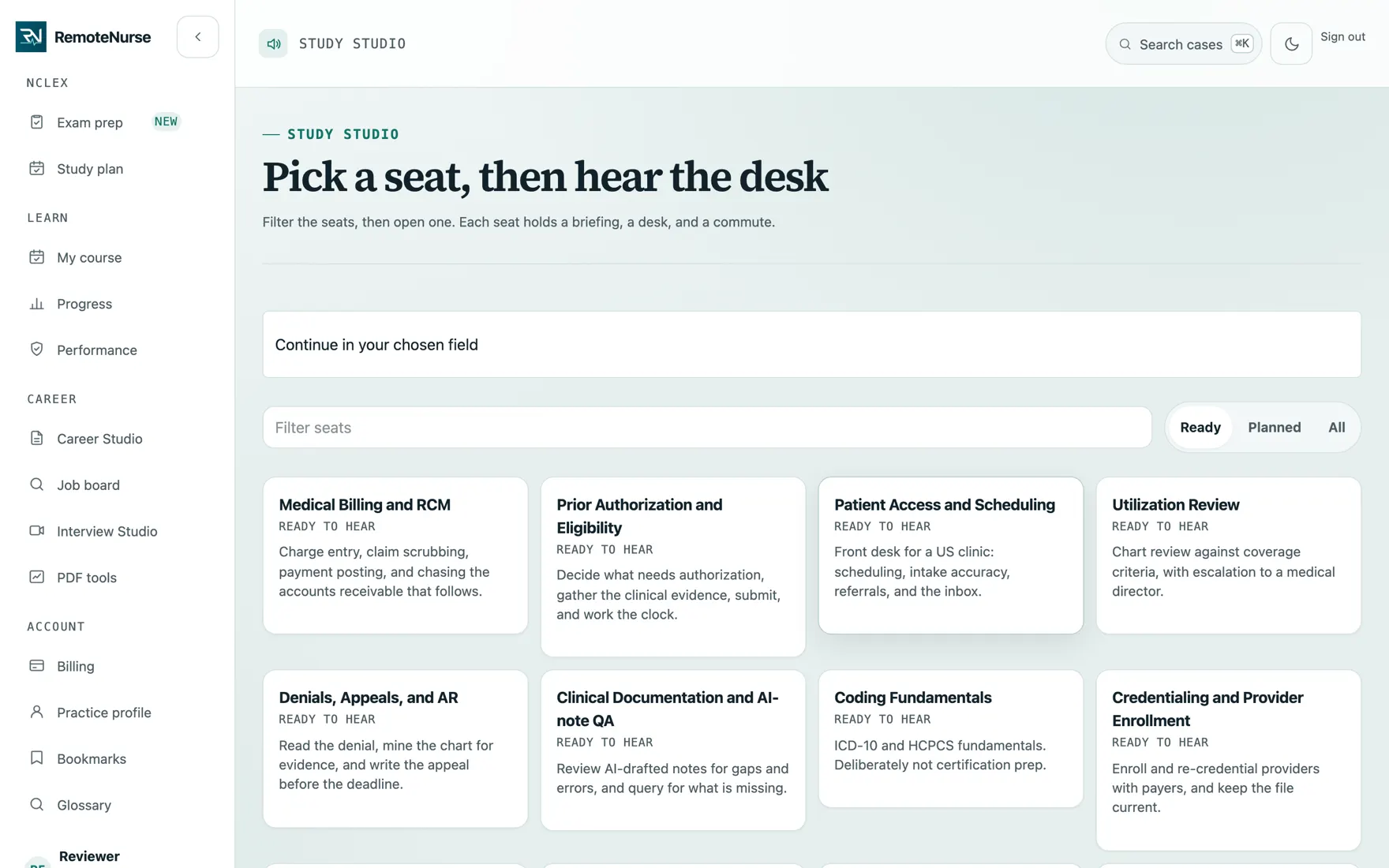
This desk draws on 13 practice tracks. You work synthetic cases in each, and a fixed rulebook scores the attempt.
Related drills: HIPAA. These are original practice items, not official examinations.
Common questions
Is credentialing a good entry point into remote healthcare work?
It is one of the more accessible ones. It needs no clinical background, the process is learnable, and it has so far resisted automation because it depends on chasing external parties for documents and status.
What is the difference between credentialing and privileging?
Credentialing verifies that a provider is who and what they claim to be. Privileging is a facility granting that provider permission to perform specific procedures there. Credentialing specialists typically support both files.
Where to go next
See live remote openings to check what employers are asking for, browse the agency directory for who staffs this work, or compare all 16 roles if this one is not the right fit.